
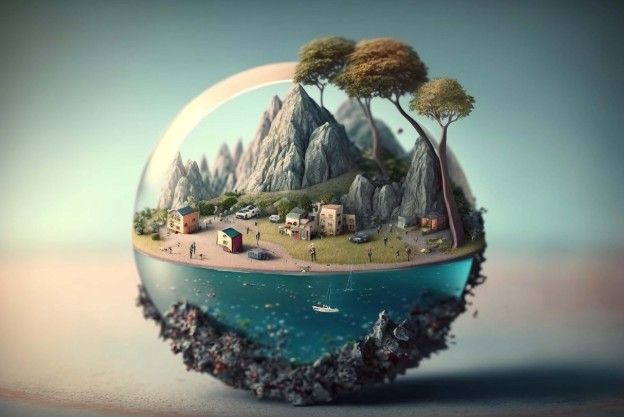
A scale becomes harder to read when a world removes objects people already understand. A city street has doors, cars, windows, and people. An underwater trench, alien plain, or fantasy cavern may have none of them. However, artists still need players to read distance and size quickly, so scale has to come from relationships inside the world.
That challenge reaches across concept work, modeling, texturing, animation, lighting, and level building. For teams using 3D art services across many asset types, a shared scale language keeps a creature, tool, rock field, and landmark readable in the same scene. Subnautica 2 is a useful current example because its art pipeline spans creatures, flora, rocks, equipment, and large underwater spaces.
Scale Starts With Relationships
A model can be exactly 40 meters long in the game editor and still look small on screen. Players judge size from visual relationships. A huge creature reads as huge when smaller creatures move around it, nearby plants repeat at a known size, particles cross its body, and its motion covers space at a pace that fits its mass.
This connects to size perception, where distance changes how large an object appears within the visual field. A giant shape placed alone in blue water may read as a small shape nearby. Add fish, suspended debris, or a ridge passing behind it, and the eye gains more information.
Relative scale also needs consistency. If a plant appears waist-high beside a vehicle in one area and tower-sized beside the same vehicle later, players require a clear reason for the change. Species variants, age, region, or mutation can explain it. Random size changes weaken the visual measure that the asset provides.
For a 3D art company, scale should be in the asset rules from the very start. Creature sheets can include flora, tools, vehicles, eggs, or rocks as comparison objects. Environment sheets can repeat them. Meter values still matter for collision and gameplay, while comparison objects handle what the player sees.
Build a Scale Language Into Creatures, Flora, and Props
In unfamiliar worlds, repeated design cues become a local measuring system. The goal is to give players several cues at once. Underwater scenes benefit because water reduces long-range detail and makes silhouettes carry more information.
A practical scale language can use:
- Nested detail sizes. Large forms should contain medium and small forms. A massive shell can have ridges, scars, parasites, vents, or growths that create visible steps from small to huge.
- Repeated world units. Schools of fish, plant clusters, mineral nodes, bubbles, and tool-sized props can appear across many areas. Repetition gives players a stable visual measure.
- Motion tied to mass. Small creatures can turn quickly, while very large bodies can take wider paths and move major limbs over longer arcs.
- Interaction marks. Bite damage, scraped rock, broken coral, nests, or displaced sand shows what an object can affect.
- Layered distance cues. Foreground particles, middle-distance flora, and far silhouettes create depth, letting a large object occupy several visual layers.
A sculptor can judge whether surface detail fits the intended size, while a level artist can test whether nearby assets support the same reading. Teams providing 3D art outsourcing services can use shared comparison scenes to keep work from different artists aligned before it reaches the final level.
Environment Design Turns Space Into a Measuring Tool
Large environments need more than a giant rock or a wide camera view. The space has to reveal its size as the player moves through it. Repetition, overlap, travel time, and visibility all contribute.
Early environment blockouts help because simple shapes expose scale problems before detail hides them. A trench wall can be tested with temporary flora, a vehicle proxy, and creature silhouettes. If the wall reads too small, artists can adjust spacing, shape rhythm, or camera placement while the scene is still simple.
Underwater worlds add another tool — visibility falloff. Objects lose contrast and detail with distance, so artists can place known shapes at several depths and let the player compare them. A reef that fades through multiple layers reads deeper than a single detailed wall. Large set pieces gain scale when parts disappear beyond the frame or into haze, while nearby objects keep the size clear.
Across 3D art companies, shared test scenes can support this process. One scene may check a creature beside common props, another may test rocks and plants across several distances, and another may test a landmark from gameplay cameras. Each asset class gets its own check while visual rules stay connected.
Props Give Strange Worlds a Human-Sized Beat
Tools and equipment are useful because players quickly learn how they fit the character’s body. A scanner, handheld light, storage case, hatch, seat, or small vehicle can become a stable reference even when the surrounding world is unfamiliar.
That makes prop design part of environmental scale. A huge wreck gains size when familiar equipment appears along its surface. A creature jaw feels larger when it closes around a vehicle the player has used. A cavern can show distance through a line of lights or beacons that shrink toward the far end. The prop supports play and gives the eye a known unit at the same time.
The same idea appears in game art that uses massive scale through perspective and depth. In production, providers such as N-iX Games can contribute to this shared visual language by working across characters, props, creatures, and environments rather than treating each asset as an isolated object.
Summary
Unfamiliar worlds communicate scale through repeated relationships. Creatures show size through motion, surface detail, nearby life, and interaction marks. Environments use overlap, depth, travel distance, haze, and repeated forms. Props give players a stable, body-sized reference that can travel into strange spaces.
The production side follows the same logic. Shared comparison assets, blockout tests, gameplay cameras, and clear detail rules keep many artists aligned. When several cues point to the same size, a giant creature, trench, alien plant, or underwater structure can be read clearly even without buildings, trees, or people nearby.
