
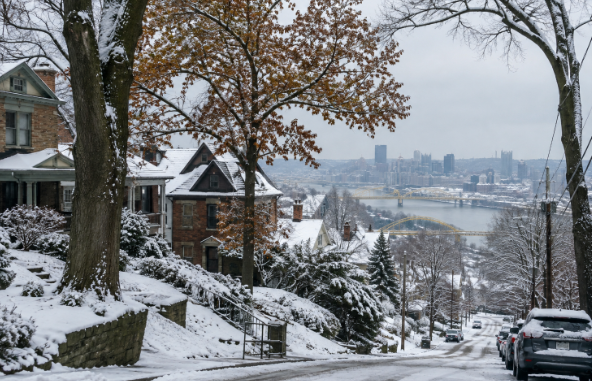
Pittsburgh’s mature neighborhoods are known for their established maples, oaks, pines, and ornamental trees. Those trees add shade and character, but they also grow close to roofs, steep driveways, sidewalks, parked cars, and utility corridors. Preparing before a storm gives homeowners more options than reacting after a limb has already failed.
For a professional perspective, Tripoli Tree Care, a trusted tree service in Pittsburgh, PA, offers tree assessments, pruning, removal, stump grinding, storm cleanup, and emergency tree care across Pittsburgh and nearby Allegheny County communities. As a locally owned company with ISA Certified Arborists, Tripoli Tree Care is familiar with the tight access, hillsides, large mature trees, and storm-related hazards that shape tree work throughout the Pittsburgh area.
Why Seasonal Preparation Matters
A tree can appear healthy from a kitchen window while concealing weak branch unions, old pruning wounds, internal decay, or root damage. Mature trees are valuable assets, and removal is not automatically the best answer. The goal is to identify conditions that increase the risk of failure, then choose an appropriate response to protect both the tree and the property below it.
Seasonal preparation also helps homeowners make decisions without the pressure of an approaching storm. A routine inspection can reveal whether a dead limb needs removal, whether branches need more clearance from a roof, or whether a tree should be monitored more closely. Addressing manageable issues early may also allow work to be scheduled during safer weather and before access is complicated by snow, mud, or emergency demand after a widespread storm.
Local Weather Risks That Can Weaken Trees
Ice and Wet Snow
Wet snow and ice add substantial weight to branches. Evergreen foliage can hold snow, while broad, spreading limbs on deciduous trees may bend or split under uneven loading. Branches that were already dead, cracked, crowded, or poorly attached are more likely to fail first.
After a heavy snowfall, look from the ground for limbs that remain sharply bent, newly split, or caught on lower branches. Do not try to knock snow or ice from high branches with a pole, rake, or ladder. The action can dislodge a damaged limb, and the person standing below is often directly in its fall zone.
Strong Wind and Saturated Soil
Wind exposes weaknesses in trunks, limbs, and roots. When soil is wet, a tree with compromised roots may lose stability more easily, especially on a slope. In Pittsburgh, a mature maple above a narrow hillside driveway can present a greater practical risk than the same tree standing in an open yard because there is little room for a falling limb to miss a target.
Wind can also cause failure at the junction of co-dominant stems. These are trunks or major stems of similar size growing from the same point. If bark is visibly compressed between them, the connection may be weaker than a branch union with a well-developed collar. This does not mean every multi-stem tree is unsafe, but it is a condition worth including in a professional assessment when the tree is large or located near a target.
Freeze-Thaw Stress
Repeated freezing and thawing can shift soil around shallow roots and reveal existing drainage or grading issues. Watch closely for fresh soil cracks, lifted roots, or changes in a tree’s angle after prolonged rain, snowmelt, or a windy weather event.
A Simple Ground-Level Tree Inspection
Walk around each large tree before storm season. Do not climb, probe cavities, or pull on branches. Instead, look from a safe distance for the following:
- Trunk concerns: Deep cracks, cavities, loose bark, large wounds, or soft-looking decay.
- Major branch unions: Narrow forks, visible splits, rubbing limbs, or bark squeezed between two stems.
- Canopy problems: Dead branches, hanging limbs, broken tops, heavy dieback, or unusually thin foliage.
- Root-zone changes: Mushrooms near the trunk base, exposed roots, lifted soil, fresh ground cracks, or a new lean.
- Nearby targets: Roofs, vehicles, play areas, sheds, fences, sidewalks, and overhead lines.
- Photos for comparison: Take clear images from the ground so changes can be monitored or shared during an assessment.
Try to inspect the whole site, not only the portion of the tree visible from the house. A tree’s roots commonly extend beyond the branch spread, and construction, trenching, soil compaction, grade changes, or repeated vehicle traffic can affect root health over time. Note recent changes around the base of the tree, including new patios, retaining work, drainage changes, or excavation, so that information can be shared with a tree care professional.
Warning Signs That Need Prompt Attention
- A new or worsening lean, particularly when paired with disturbed soil or exposed roots.
- Large dead limbs over a driveway, roof, walkway, or gathering area.
- Fresh cracks where two major stems join.
- Fungal growth at the base together with soft, crumbling, or hollow wood.
- Large areas of missing bark or deep trunk wounds.
- Broken branches suspended in the canopy after wind or snow.
One sign alone does not prove that removal is necessary. Risk depends on the tree’s size, structure, health, location, and the likelihood that people or property could be struck if part of it fails.
Changes that happen quickly are especially important. For example, a tree that has leaned slightly for many years may require a different response than a tree that shifts after a period of rain and wind. Keep family members, visitors, and vehicles away from the area if there is any concern about imminent movement, and seek an assessment rather than testing the tree yourself.
Pruning and Tree Care Before Severe Weather
Thoughtful pruning can remove dead or broken limbs, reduce rubbing between branches, improve clearance, and address selected structural defects. Proper work should preserve the tree’s natural form rather than simply making it shorter. Penn State Extension’s guidance on pruning landscape trees explains why careful removal and reduction cuts are preferred over indiscriminate cutting.
For younger trees, structural pruning can be particularly useful, as it helps encourage well-spaced branches and, where appropriate for the species, a dominant central leader. For established trees, the focus is often more conservative: removing deadwood, reducing an overextended limb when justified, and maintaining clearance from buildings or paths without stripping out excessive live foliage at one time.
Homeowners should avoid topping trees, climbing with a chainsaw, cutting large limbs from a ladder, working near utility lines, or trying to pull down a hanging branch. Topping can lead to weak regrowth and future decay concerns. Large, heavy, or damaged limbs can move unpredictably when cut.
Pittsburgh Property Challenges to Consider
Steep slopes, narrow side yards, historic homes, close property lines, and limited street access affect how safely tree work can be performed. Equipment may need to be positioned carefully to avoid landscape damage, and large limbs may need controlled lowering rather than a simple drop. Before removing a tree near a sidewalk, street, utility corridor, or boundary line, check the requirements that apply to the property’s municipality and the tree’s ownership.
Access planning matters just as much after a storm. A fallen limb may block a shared driveway, rest against a fence, or extend across more than one property. Avoid assuming that a visibly damaged tree can simply be cut at the property line. When ownership, access, or utility clearance is unclear, pause before work begins and document the condition with photographs.
What to Do After a Storm
- Keep people and pets away: Do not stand beneath broken limbs or approach a leaning tree.
- Treat downed lines as energized: Stay clear of the line, tree, and nearby objects, then report the hazard to the utility company or emergency services.
- Document safely: Take wide photos from a secure location before cleanup, particularly when a structure has been damaged.
- Contact your insurer: Ask what documentation is needed before authorizing extensive work.
- Arrange an assessment: Have major trunk, root, or canopy damage evaluated before cutting begins.
If a limb is resting on a roof, vehicle, fence, or another tree, resist the urge to cut it free. Removing one point of support can cause the remaining portion to swing, roll, or drop unexpectedly. Emergency work should prioritize making the site safe and preventing additional damage, while non-urgent cosmetic cleanup can usually wait until the situation has been assessed.
Pennsylvania’s severe-storm safety guidance also emphasizes avoiding fallen trees and power lines, reporting hazards, and using photos to record damage before cleanup.
When to Call a Professional Tree Care Team
Professional help is appropriate when a tree is large, storm-damaged, leaning, or close to a structure or utility lines. Ask for a written estimate, proof of insurance, a clear debris plan, and an explanation of whether pruning, cabling, bracing, monitoring, or removal is recommended. A qualified team should be able to explain why a particular course of action fits the tree and site.
It is also reasonable to ask how the crew plans to access the tree, protect nearby surfaces, and handle wood or brush after the work is complete. For trees near energized conductors, homeowners should contact the utility provider rather than arranging ordinary pruning around the lines. Utility-line clearance requires specialized procedures and should never be treated as a routine do-it-yourself task.
Frequently Asked Questions
Should every storm-damaged tree be removed?
No. Some trees can be retained through selective pruning, support systems, or monitoring. The remaining structure, wound size, decay, location, and exposure to people or property all matter.
Is it safe to remove snow from branches?
Avoid climbing or forcefully shaking heavily loaded branches. Large limbs can break suddenly, and snow-covered ground adds slip hazards.
When is the best time to prune in Pittsburgh?
Timing depends on the species, pruning objective, and tree condition. Dead, broken, or immediately hazardous limbs may need attention regardless of season.
What if a tree falls on a power line?
Stay away, keep others back, and contact the utility company or emergency services. Never touch the tree, wire, fence, vehicle, or puddle near the affected area.
Storm readiness begins well before the forecast becomes urgent. Careful inspection, sensible pruning, and timely professional advice can reduce avoidable hazards while helping Pittsburgh homeowners preserve healthy, mature trees for years to come.
