
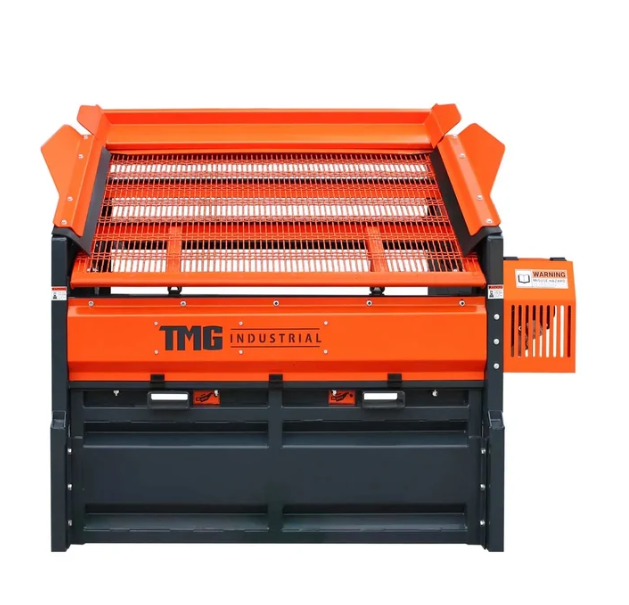
Operators who put a soil sifter to work on topsoil after rain learn this within ten minutes. The mesh fills, material stops passing, and the machine runs with nothing coming out the bottom. Nothing has broken and no setting is wrong; the soil is simply wet enough that particles stick to each other and to the wire instead of separating.
This is the governing constraint on every screening operation and it is rarely in the specification. A soil sifter rated for a given throughput was measured on material at a workable moisture content, and the gap between that and a damp spring stockpile is larger than any difference between competing machines.
Why Wet Material Blinds a Screen
Blinding is the term for mesh openings on a soil sifter plugged by material that neither passes through nor moves off. Moist fines bridge across an opening, more fines stick to them, and within a few passes the effective open area of the screen has dropped substantially while the apparent screen size has not changed at all.
Clay content makes it worse than water alone does. Clay particles are plate-shaped and cohesive, so a soil with significant clay will blind at a moisture level where a sandy loam still runs freely. The same machine therefore behaves completely differently on two piles from the same property.
Vibration is the defense, which is why these machines vibrate rather than simply tilt. Acceleration at the mesh surface knocks lodged particles loose and keeps the openings clear, and that is also why a vibrating screen outperforms a static rack by a wide margin on anything other than bone-dry material.
Amplitude and Angle Set the Travel Rate
Two adjustments govern how fast material crosses the screen. Amplitude is how far the mesh moves per cycle, and it controls how energetically particles are thrown clear of the surface. Angle controls how quickly gravity carries them toward the discharge end.
A steep angle moves material fast and screens it poorly, because each particle spends less time over open mesh. A shallow angle screens thoroughly and risks building a bed of material deep enough that the lower layer never reaches the wire. The useful setting for a given material sits between those failures.
Bed depth is the observable symptom of getting it wrong. A thin, evenly spread layer with visible mesh between particles is working correctly; a rolling heap traveling down the screen is not, regardless of how much material is going in the top.
Mesh Size Versus Particle Shape
Mesh is specified by opening dimension, and a particle passes if it can present a small enough cross-section. Flat and elongated particles therefore behave unpredictably: a flake of shale much larger than the opening will pass edge-on, which is why screened material sometimes contains pieces that appear too big for the mesh.
That effect works in the operator’s favor when separating rock from soil, since rounded stones present the same dimension in every orientation and are reliably rejected. A vibratory topsoil rock screen is doing exactly this job, and the consistency of rounded aggregate is what makes the separation clean.
Used as a rock separator rather than as a fines classifier, the machine is also far more tolerant of moisture, because the target product is the coarse fraction rather than the sticky one. Operators who need stone out of a pile can often work in conditions that would stop a job aimed at producing screened topsoil.
Wire diameter is the specification buyers overlook. For a given opening, heavier wire means less open area and lower throughput but much longer life. On abrasive material the heavier wire usually wins on cost per yard screened even though it screens more slowly.
Feed Rate Is the Variable Operators Control
Everything above is fixed once the soil sifter is set up. Feed rate is not, and it is the single lever that fixes most screening problems. Overfeeding buries the mesh and sends good material out with the oversize; underfeeding wastes machine time but never damages the result.
The practical method is to find the rate at which the discharge stays clean and then stay slightly below it. Loader operators tend to feed in surges because that is how a bucket empties, and a feed hopper that buffers those surges into a steadier stream improves output without changing anything on the screen itself.
Stockpile management closes the loop. Material turned and allowed to dry for a day or two screens far better than material taken straight from a wet pile, and on a damp site that waiting period produces more finished product than any adjustment to the machine would. Anyone running a compost screener through the same seasons will have reached the same conclusion from the other direction. TMG Industrial lists screen area, mesh options, and required drive alongside the throughput figure, and reading those together is what makes a throughput number meaningful for a particular material.
