
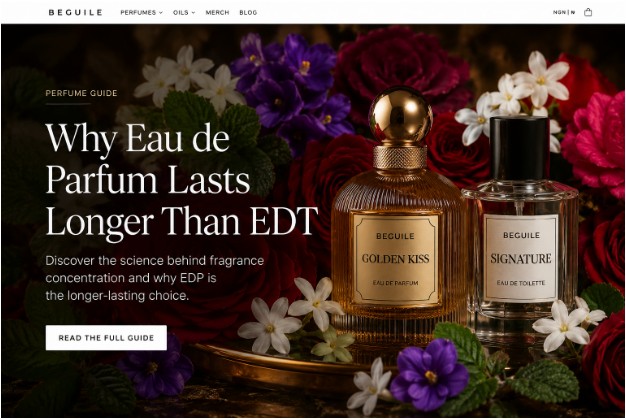
I can’t count how many times I’ve sprayed on a fragrance in the morning, only to catch myself sniffing my wrist at lunch and wondering where it went. For years, I blamed my skin chemistry or the weather. Turns out, the real answer was sitting right there on the bottle the whole time: the concentration type. Once I understood the difference between Eau de Parfum and Eau de Toilette, my entire approach to buying and wearing perfume changed.
If you’ve ever compared two bottles from the same fragrance family and noticed one clings to your skin for hours while the other fades before you finish your coffee, you’ve experienced the EDP vs EDT divide firsthand. This isn’t marketing fluff, it’s chemistry. The reason comes down to how much actual fragrance oil is packed into the bottle versus how much is diluted with alcohol and water. That single ratio is the biggest factor in fragrance longevity, and it’s why I now check the label before I check the price. It’s also why, when I want something that survives a full workday without a midday reapplication, I reach for the Beguile Eau de Parfum collection instead of lighter alternatives.
The Concentration Difference, Explained Simply
Perfume concentration refers to the percentage of aromatic compounds in a fragrance relative to its carrier (usually alcohol). Eau de Parfum typically contains around 15–20% fragrance oil, while Eau de Toilette usually sits between 5–15%. That gap might look small on paper, but on skin it’s the difference between a scent that whispers and one that lingers.
Think of it like brewing coffee. A concentrated espresso shot delivers a bold, lasting flavor with just a small amount of liquid. A watered-down cup, even from the same beans, tastes weaker and fades faster on your palate. Fragrance oils behave the same way as more concentrated formulas release their scent molecules more slowly and steadily, which is exactly what gives Eau de Parfum its staying power.
Why the Oil-to-Alcohol Ratio Matters So Much
Alcohol is volatile, it evaporates quickly, and it takes some of the lighter top notes with it. When a fragrance has less oil and more alcohol, as EDT does, you get an immediate impression that dissipates within a couple of hours. EDP’s richer oil content means the scent molecules are released gradually over a much longer window, often eight hours or more, because there’s simply more raw material sitting on your skin working its way through the notes.
This is also why an EDP tends to smell “deeper” or “warmer” over time, while an EDT can feel like it disappears in stages, sometimes vanishing entirely by early afternoon.
Skin Type and Application Still Play a Role
Concentration isn’t the only variable in fragrance longevity. Dry skin holds scent less effectively than oily skin, since natural oils act as an anchor for fragrance molecules. Where you apply also matters pulse points like wrists, neck, and behind the ears tend to hold scent longer because of natural body heat. But even accounting for these factors, an Eau de Parfum will almost always outlast an Eau de Toilette version of the same scent, because the underlying formula is doing more of the work.
Is EDP Worth the Higher Price?
EDP bottles usually cost more than EDT versions, and I understand the hesitation. But when you factor in how much less product you need a couple of sprays instead of a full reapplication throughout the day the value evens out quickly. You’re not just paying for concentration; you’re paying for fewer touch-ups and a scent that actually represents you consistently from morning meetings to evening plans.
This is exactly why, when I’m shopping for something meant to last, I steer people toward the Beguile Eau de Parfum collection. Each formula is built with a higher concentration specifically so the fragrance holds its shape for hours, rather than fading into something thin and forgettable by midday.
The Bottom Line
The next time you’re deciding between EDP vs EDT, remember it’s not just a label it’s a formula decision that directly affects how long your fragrance lasts. If you want something that survives from your morning commute to your evening plans without a reapplication, Eau de Parfum is the clear choice.
